
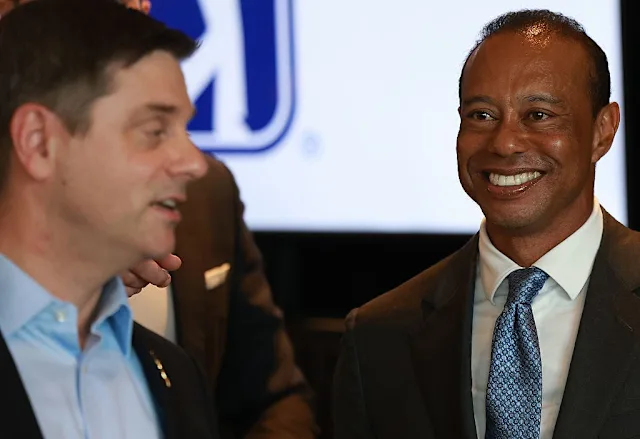
Tuesday at the Travelers Championship in Cromwell, Connecticut, PGA Tour CEO Brian Rolapp stood up and announced the most significant structural overhaul in the Tour’s history. It goes into effect in 2028. Here’s what you need to know.
Two series. One Tour.
Starting in 2028 the PGA Tour splits into two distinct tiers: the PGA Tour Championship Series for the game’s elite, and the PGA Tour Challenger Series as the primary pathway to get there. Think of it less like a rebrand and more like the Premier League and the Championship finally coming to professional golf. The best play at the top. Everyone else fights to get there.
The Championship Series
The Championship Series will feature up to 24 events, including the four major championships, The Players, the Presidents Cup or Ryder Cup depending on the year, and a reimagined postseason. The regular season runs February through August. Fields are capped at 120 players, minimum purse is $20 million per event, no sponsor exemptions, no alternate list, 72 holes with a 36-hole cut to the top 65 and ties.
Ten of the 15 regular season Championship Series events are already confirmed, all current signature events. The remaining five spots are being filled from larger markets: Boston, Denver, New York, Philadelphia, San Francisco, Seattle, and Washington D.C. are all in consideration.
The Challenger Series
The Challenger Series offers a minimum of 20 events with purses of at least $4 million, played at distinguished venues that have traditionally hosted PGA Tour events. Fields of approximately 144 players, 72 holes, 36-hole cut to the top 65 and ties. Championship Series players are not eligible to compete.
Promotion and relegation
This is the part that changes everything about how players think about their careers. At minimum, the top 90 finishers out of approximately 130 Championship Series players retain their membership the following season. Those who fall short risk relegation to the Challenger Series. A minimum of 20 players from the Challenger Series earn promotion to the Championship Series each year.
There will also be a “last chance” series of four to six fall events where a limited number of Championship Series spots for the following season are up for grabs. Q-School continues to exist as an entry point into the broader ecosystem.
Match play is back
The Tour Championship will no longer be held annually at East Lake in Atlanta, ending a run that began in 2004. The reimagined postseason introduces match play, moving to a two-week format starting with a group stage and culminating in a bracket to determine the champion. The regular season points leader gets their own separate recognition. Two champions, two different kinds of glory.
The international piece
Top Championship Series players will also be eligible for a limited international series of fall events in partnership with the DP World Tour, likely including events like the Australian Open.
Who was in the room
Tuesday at TPC River Highlands was Tiger Woods’ first public appearance since his DUI arrest in March and subsequent rehab in Europe. The most famous golfer who ever lived showed up to introduce Brian Rolapp at the podium, and the room understood exactly what that meant.
Woods chaired the nine-member Future Competition Committee that Rolapp formed in August 2025, one of his first moves as CEO. The player representatives were Patrick Cantlay, Maverick McNealy, Keith Mitchell, Adam Scott, and Camilo Villegas. The business advisors were Joe Gorder, former Valero Energy CEO and current PGA Tour Board Chairman, John Henry, Fenway Sports Group founder, and Theo Epstein, the former baseball executive who engineered championship turnarounds in Boston and Chicago and has become deeply embedded in golf’s modernization conversation.
Epstein is the most interesting name on that list. The man who invented the analytics-driven roster rebuild and shepherded pitch clocks and shift bans through a resistant baseball establishment was brought in specifically because the Tour needed someone who understood how to push structural change through a complicated, tradition-heavy ecosystem.
Woods addressed the room with the phrase that actually matters: “This work was bigger than any one player or person. It was about designing the strongest possible version of the PGA Tour for future generations of fans and players.”
And the fact that he flew back from rehab in Europe to stand at that podium and say it says something about how seriously the people driving this actually believe in it.
The elephant in the room
Nobody at the podium mentioned LIV Golf by name. They didn’t have to. Rolapp’s letter to fans said the new model exists because fans wanted to see the best players competing against each other more often, with clearer stakes and a more dramatic finish to the season. That’s also a pretty clean description of what LIV’s format was supposed to deliver and largely didn’t. Whether the two-tier model actually achieves it is a question for 2028.
The details still being finalized are significant: specific Championship Series markets and venues, full points system mechanics, postseason format specifics. Those are expected in early 2027.
For now, the structure exists. Professional golf just got a promotion and relegation system. What happens next is anybody’s guess.

Leave a Reply