
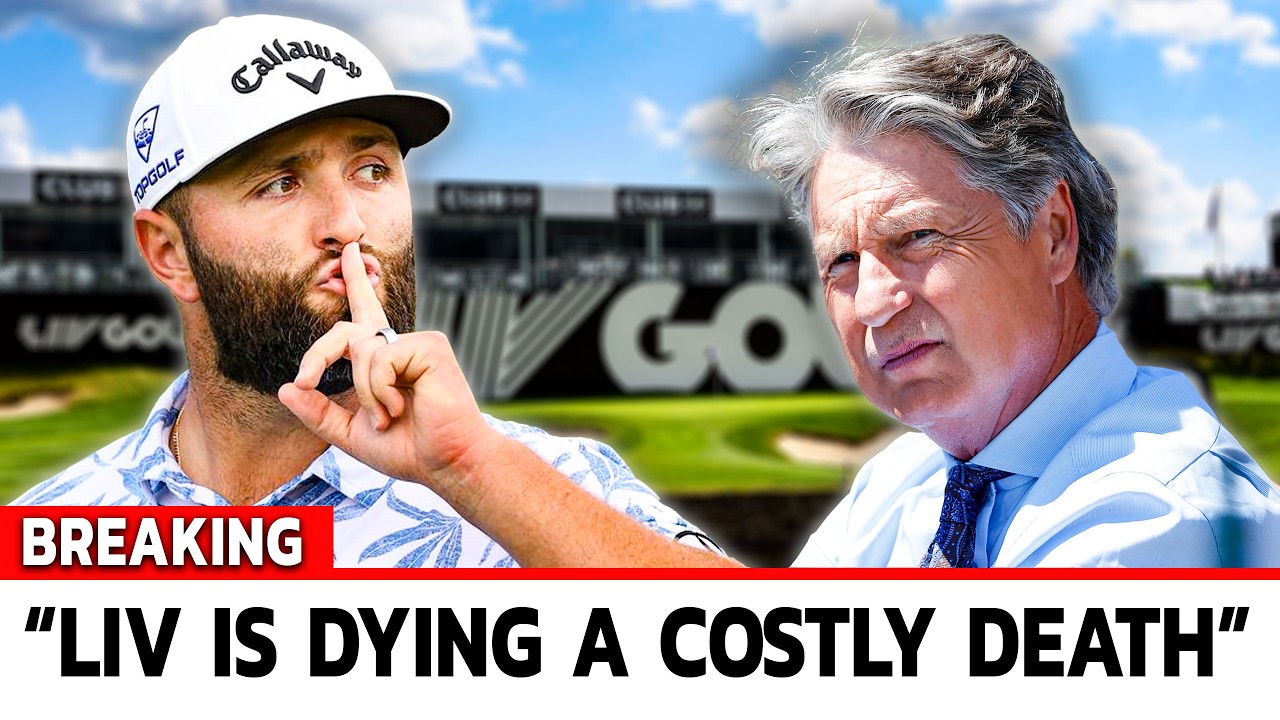
LIV Golf died, on the internet, this week. Golf Twitter spontaneously combusted and started writing obituaries. The rumors this week had more teeth than usual.

On Tuesday night, Ryan French, who runs Monday Q Info (@acaseofthegolf1) and has ~200,000 followers, didn’t just tweet a rumor. He went on X Spaces and said: “I think everybody should probably stay near their phones. It’s happening. It’s definitely happening. I’ve got everything from people that I trust that you guys know: players didn’t get paid today, power went out because the bill wasn’t paid, employees didn’t get paid. Things are not good.”
That is a specific, sourced claim from someone with a real track record. It landed accordingly.
By Wednesday morning, the Financial Times had reported that the Public Investment Fund was “on the verge” of cutting support. The Telegraph reported LIV executives had been summoned to an emergency meeting in New York. LIV’s media center in Mexico City had not opened on Tuesday. Jon Rahm’s scheduled press conference was cancelled, officially attributed to technical difficulties in the media center.
Then came the player quotes, and they told two different stories at once.
Sergio Garcia, asked directly at a Fireballs GC press conference, said in Spanish: “We have not heard anything. That is not what Yasir told us at the beginning of the year, that he is behind us, that they have a project of many years. There are always many rumors. I cannot comment on anything more than what we know.”
Several other players contacted by the Telegraph on Wednesday morning “insisted it was business as usual as they went about their preparations.” Tom Hobbs, who runs the LIV-focused Flushing It (@flushingitgolf) account and has direct access to the circuit, posted: “I’ve spoken directly to multiple people within LIV Golf who all say they have had no issue with being paid. Future venues are proceeding as normal, with no indication that anything will change.”
So the players in Mexico knew nothing, or said nothing. By Wednesday evening, CEO Scott O’Neil sent an all-staff letter: “I want to be crystal clear: Our season continues exactly as planned, uninterrupted and at full throttle.” LIV released Thursday tee times. Upcoming venues had not been notified of any changes. Multiple reports landed saying PIF intends to fund LIV through the rest of 2026.
The tournament is happening. The rumor cycle has, for now, been contained.
But the more interesting questions are the ones it kicked loose. Specifically: what do these player contracts actually look like, and what happens to the money if LIV really does go dark?
What the Contracts Actually Say
LIV contracts are not a single standard deal. There are effectively three tiers, and they matter a lot if the league ever winds down.
The top tier is the one that got all the headlines. Phil Mickelson, Dustin Johnson, Bryson DeChambeau, and the founding-era names signed eight and nine-figure guaranteed contracts, paid in annual installments across three, four, or five-year deals. DeChambeau reportedly landed a $125 million guarantee when he signed, with roughly half paid upfront. The numbers reported elsewhere have ranged higher, though agents who spoke to Golf Digest acknowledged those figures get inflated for recruiting purposes. The key word is installments. These players are not sitting on completed paydays. They are drawing from a future payment stream.
The mid-tier players, established names who made the jump without superstar leverage, received smaller guarantees. Some, like Pat Perez, confirmed their money came in one lump sum upfront. For them, financial exposure in a shutdown is lower.
The bottom tier is purely performance-based. No floor beyond last-place prize money, currently $120,000 per event in a no-cut format. If an event cancels, that check disappears.
Beyond the money, the contracts carry real restrictions. Players must compete in every scheduled event. LIV owns all on-course media rights in perpetuity. Interview approval runs through LIV management. Players must wear team apparel and actively assist in recruiting other golfers to join the league. There is a morals clause covering on-course cheating, legal trouble, and gambling contact, with clawback provisions on guaranteed money. Multi-year deals also include injury clawbacks.
What players do retain: name, image, and likeness rights outside LIV events, all prize money earned on course separately from any guarantee, a $1 million bonus per major win, and for some players, equity in team sponsorship rights.
If the Lights Go Out
For players in the installment tier, a shutdown means an immediate breach of contract claim against remaining installments. The problem is who you are collecting from. Pursuing a breach claim against a Saudi sovereign wealth fund entity in a wind-down is a different exercise than collecting from a US sports league. It would be painfully slow, expensive, and the outcome is uncertain.
Players who took lump sum deals upfront are largely insulated, unless a force majeure or morals clause is successfully invoked to trigger a clawback.
Prize-money-only players have nothing to collect. If the event does not happen, the check does not exist.
The PGA Tour door is effectively closed for most of the field. The Returning Member Program requires winning the Players Championship or a major since 2022. Of the four eligible players, only Koepka took it, absorbing the financial penalties. DeChambeau, Rahm, and Smith’s return window closed in February. As of January, DeChambeau was still publicly hedging on his contract extension, telling Flushing It Golf: “I mean, look, it’s confidential. I’m not going to share too much, but the conversations are in process. We have to get to a place where both parties have a good understanding of one another.” He had also floated the idea of playing the four majors independently and skipping both tours entirely as “an incredibly viable option.” That is useful leverage in a negotiation. It is a less comfortable position if LIV evaporates before the deal gets done.
Dustin Johnson, by contrast, already signed a multi-year extension in January. “This team is built for big moments,” he said at the time.
The Masters performance last week added an awkward subplot. DeChambeau missed the cut after rounds of 76 and 74. Rahm, the 2023 champion, shot a first-round 78 and finished T-38. For players whose negotiating leverage depends on remaining elite, that is a problem independent of whatever PIF decides.
The Force Majeure Rumor
This is where it gets genuinely interesting, and genuinely murky.
Alan Shipnuck, @AlanShipnuck, one of the most plugged-in reporters on this beat, posted Wednesday that a player agent had texted him: “Have heard MBS wants to use the war as Force Majeure to pull the plug.” MBS is Mohammed bin Salman, Saudi Arabia’s de facto ruler and the power behind PIF. Shipnuck followed up though with: “No one knows anything.”
Force majeure clauses allow a party to exit a contract without liability when an extraordinary, unforeseeable event makes performance impossible or commercially impractical. War qualifies in most legal frameworks. Saudi Arabia’s regional exposure to the Israel-Iran conflict is real, and PIF published its 2026 to 2030 strategy on Wednesday, explicitly shifting its posture from “growth and expansion” to “investment efficiency and sustainable value.” Notably, there was no mention of LIV Golf anywhere in that strategy document. That is not a coincidence of timing.
The legal problem with invoking force majeure here is that LIV is actively playing golf in Mexico City this week. The war did not cancel the tournament. It did not make performance impossible. Using an ongoing regional conflict to void player contracts while simultaneously running a $30 million event is a hard argument to make in front of a judge.
Players’ lawyers are almost certainly gaming this out right now. Whether MBS actually tries it, and whether it holds up, are two separate questions. The rumor being out there at all tells you something about the temperature inside the negotiations.
LIV claims $100 million ahead of last year in revenue, tickets up 129 percent. It has also lost money every single year since 2022, with PIF spending roughly $100 million per month to keep it running. Operating losses hit $394 million in 2023 alone, an increase of $150 million over the prior year. UK company filings showed more than $1 billion in total losses through October 2025.
Fox News’ Bret Baier reported Wednesday that PIF will fund LIV through the end of this season, but that “the Saudis’ funding will definitely come to an end at the end of this LIV season, citing a change of priorities.”
The league is not collapsing this week. But if Baier’s sourcing holds, the players have roughly eight tournaments to figure out what comes next. The force majeure whisper, the missing contract extension for the league’s biggest star, and the $6 billion that has already been spent all point to the same place. The question is not whether this ends. It is how.
Leave a Reply