
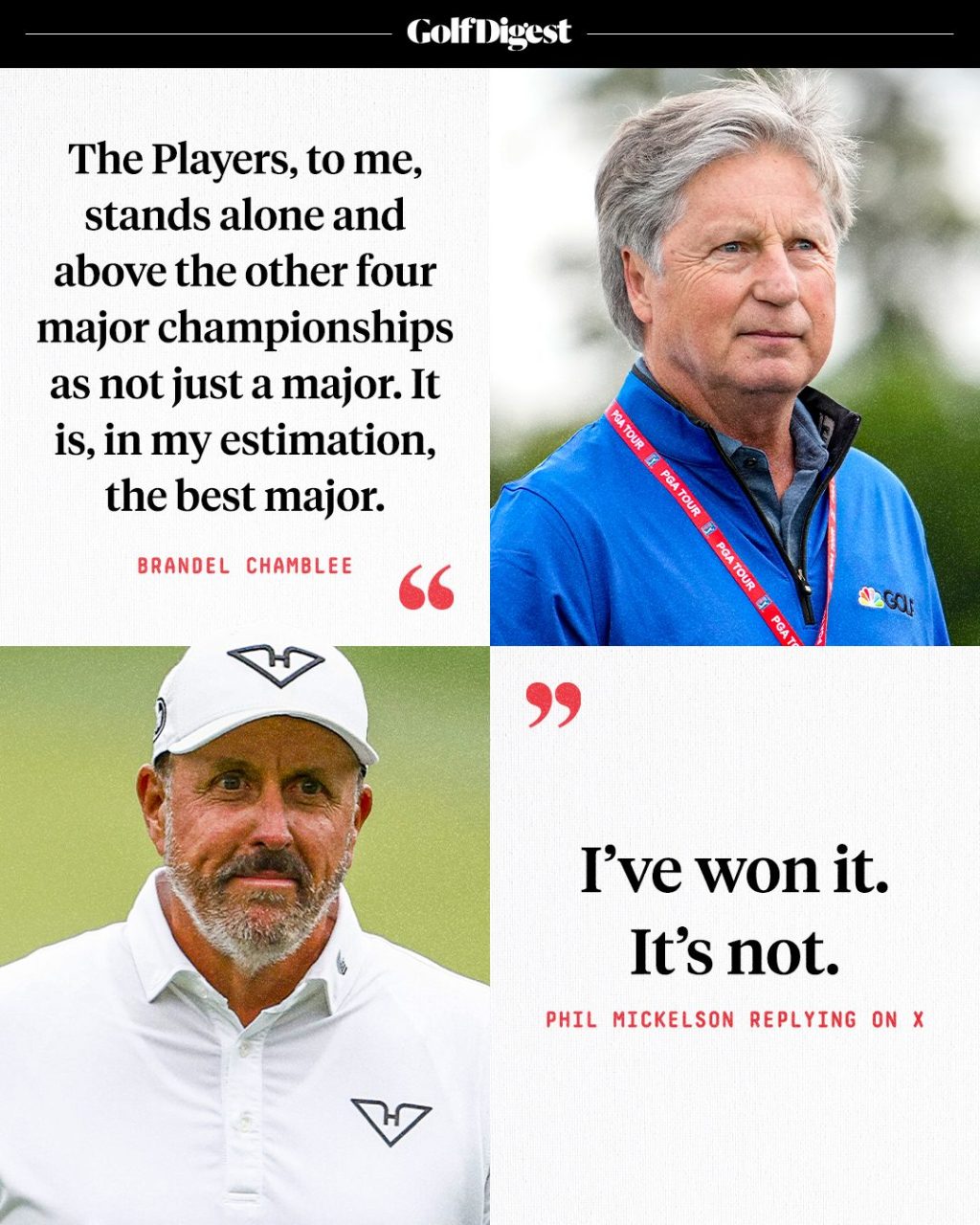
Brandel Chamblee said the quiet part out loud. During a Golf Channel segment at the WM Phoenix Open, Brandel (known for hot takes) dropped this bomb: “The Players, to me, stands alone and above the other four major championships as not just a major, it is in my estimation, the best major.”
Phil Mickelson fired back instantly. “I’ve won it. It’s not.” Philly Dilly!
And just like that, golf’s most deliciously pointless argument was back. In fact, even the boys at ForePlay golf podcast (a Barstool joint) has covered the topic at least twice if my recent memory serves.
The Players Championship has walked this strange tightrope for decades now. Too big to be just another tournament. Too new to sit at the Major, err adults’, table. The unofficial fifth major that isn’t actually a major at all.
But Chamblee’s take raises a question nobody really wants to answer: who actually decided what counts as a major in the first place?
The History No One Talks About
The four majors weren’t carved into stone tablets and delivered from the golf gods. They’re basically the result of timing, geography, and one guy’s very good idea about how to sell newspapers.
The Open Championship started in 1860. Just a bunch of Scottish pros playing for a belt. It was “the championship” because it was the only championship. The US Open came along in 1895 because Americans wanted their own thing and weren’t about to sail across the Atlantic every year. The PGA Championship showed up in 1916 as a match play event (completely different vibe than today). And the Masters? Bobby Jones and Clifford Roberts literally invented it in 1934.
The Masters, the tournament that feels like it’s been around since golf began, is younger than your grandparents. Possibly younger than you, depending on how old you are and how good your genetics are.
The modern concept of “the four majors” didn’t even solidify until the 1960s. Arnold Palmer won the Masters and US Open in 1960, and somewhere between Cherry Hills and St Andrews, the idea of a professional Grand Slam was born. Whether Palmer and Pittsburgh sportswriter Bob Drum cooked it up on a trans-Atlantic flight (as Palmer claimed) or whether it was already floating around in print (as some research suggests). What matters is this: somebody basically just decided these four tournaments were the big ones, and everyone agreed.
That’s it. That’s the whole origin story.
Who’s Actually In Charge Here?
Spoiler: nobody.
There is no governing body that crowns majors. No International Major Championship Committee. No secret golf Illuminati deciding what counts and what doesn’t.
Each major is run by a different organization. The R&A handles The Open. The USGA runs the US Open. The PGA of America owns the PGA Championship. Augusta National operates as a private club that happens to host the Masters. They’re completely separate entities. They don’t answer to anyone. They just… exist.
The Players Championship? That’s run by the PGA Tour itself. Which creates an interesting problem. The Tour can’t exactly declare its own event a major without looking like the kid who gives himself an award at his own birthday party.
Could someone just add a fifth major? Technically? Sure. Realistically? It would require consensus among players, media, sponsors, and fans. You need history, gravitas, and universal buy-in. You can’t manufacture that overnight, no matter how much money you throw at it.
The real power isn’t in some official designation. It’s in TV contracts, player commitment, and the collective agreement that these tournaments matter more than others.
Which brings us back to Chamblee’s argument.
The Case For The Players
If you strip away tradition and history and just look at the raw numbers, Chamblee has a point.
The Players consistently has the deepest field in golf. Data Golf found that the average skill level of the field at The Players is higher than any of the four majors, particularly in the bottom 25% of the draw. The Masters lets in club champions and past winners who haven’t been competitive in years. The Players? You have to earn your way in through current performance.
The course matters too. Pete Dye’s Stadium Course at TPC Sawgrass isn’t some old-money country club with a pedigree. It was specifically designed to favor no particular style of play. In 50 years, only one player (Tiger Woods in 2013) has successfully defended the title. Chamblee calls it the hardest major to win. The stats back him up.
Then there’s the island green 17th. More drama per square foot than any hole in golf. Tiger’s “better than most” putt. Sergio’s meltdown. Every year, that hole produces moments that live forever on highlight reels.
The purse is massive. The winner gets a five-year Tour exemption. Nearly every top-ranked player shows up. If you’re measuring by field strength, difficulty, and prestige, The Players checks every box.
Except one. The label.
The Rickie Problem (And What It Means For Legacy)
Let’s run a thought experiment. Tomorrow morning, the golf world wakes up and collectively decides: The Players Championship is now the fifth major. Retroactively. Every past winner now has “major champion” on their resume.
Rickie Fowler, who won in 2015 with one of the most clutch finishes in tournament history, is suddenly a major winner. The guy who’s spent his career as “best player never to win a major” gets the weight of that label lifted overnight.
Does that change how we see his career? Does it feel earned? Or does it feel like we’re moving the goalposts?
What about Tiger Woods? He’s won The Players three times. Do those suddenly count toward his major total? Does 15 become 18? If so, does that cheapen his actual majors? Or does it not matter because he’s GOAT?
The truth is, legacy in golf is absurdly fragile. Phil Mickelson is remembered differently because he never won a US Open. If he had, same career, same wins, totally different narrative. Sergio Garcia wandered in the wilderness as “the best never to win a major” until he finally grabbed a green jacket at 37. One win changed everything.
Adding a fifth major would rewrite a bunch of those stories. Some guys would benefit. Some would lose the thing that made them interesting. And the players with 15-18 majors? Their accomplishments would suddenly need context and footnotes.
But, honestly, who cares? As an avid fan, and hacker, I for one do not.
The International Angle
Here’s something Americans conveniently forget: the rest of the world might not care.
The Players is a very Florida tournament held in March on a course that, while challenging, doesn’t have the same soul as St Andrews or Royal Troon. And, would Rory McIlroy or Jon Rahm or Viktor Hovland value a Players win the same way they value lifting the Claret Jug? Probably not.
Geography matters when you’re talking about legacy. The majors rotate. They move. They represent different traditions and styles of play. The Players is locked into one American venue forever. That’s not inherently bad, but it does limit its global mystique. Counter-point: The Masters at Augusta National.
The Truth About Tradition
Here’s what makes this whole debate fascinating: majors are whatever we collectively decide they are. They weren’t sacred 100 years ago. They evolved. The PGA Championship used to be match play. The Masters didn’t exist. Arnold Palmer essentially invented the modern Grand Slam concept as a marketing tool.
So maybe The Players is already functionally a major. Maybe it just needs another 50 years before people stop questioning it. Or maybe the label is the only thing that actually matters, and without it, The Players will always be stuck in this weird limbo.
Either way, Brandel kicked the hornet’s nest on purpose. Phil clapped back with the confidence of someone who’s actually won the thing. And the rest of us get to argue about what “counts” in a sport where the rules were made up by a handful of people who just decided this is how it works.
Golf is weird about tradition… until it isn’t. The LIV money suddenly made everyone rethink everything. Player equity became a thing. The Tour restructured. Guys started jumping back and forth. Maybe one day we look back and realize The Players became a major the same way the Masters did. Not because someone declared it. But because we all just started treating it that way.
Links:




 Golf0clock
Leave a comment